
A Fresh Start in Education: a new school every year, better conditions and more respect for our educators
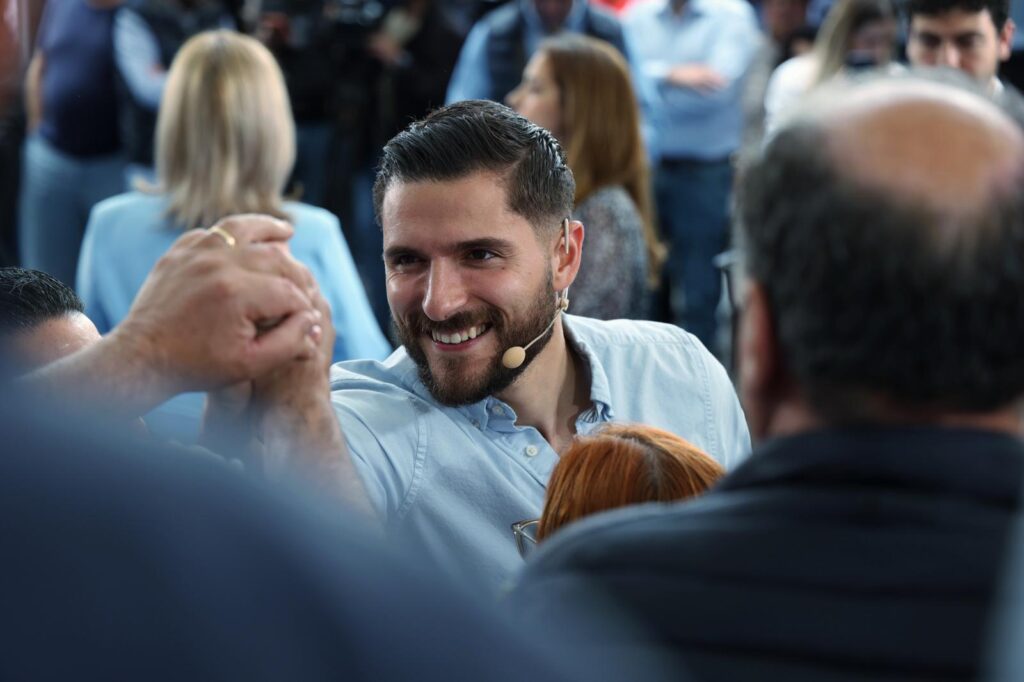
PN Leader Alex Borg in Żebbuġ: A new Nationalist Government will once again place students, teachers and families at the heart of education policy

PN Leader Alex Borg in Żebbuġ: A new Nationalist Government will once again place students, teachers and families at the heart of education policy
A new Nationalist Government will once again make education a national priority, with serious investment in schools, in the conditions of teachers and LSEs, in students, in the curriculum and in the skills needed for the world of work.
This was the message delivered by Partit Nazzjonalista Leader Alex Borg during a political discussion on education held this morning in Żebbuġ, where he said that education is not only about schools, exams or statistics, but about the future of our children, the quality of life of families and the kind of country we want to leave to future generations.

He said that a Partit Nazzjonalista in government wants to immediately sit down with the social partners to discuss a new financial package for educators, while immediately addressing the challenges faced by Learning Support Educators and investing more in them. Beyond this, it also wants to invest seriously in infrastructure, with a new school every year, so that students have a comfortable and modern place in which to learn and educators have a dignified workplace equipped with the best resources.
Alex Borg also said that a Nationalist Government will make multi-sensory rooms a priority in every school and educational entity. These rooms provide a calm, safe and suitable environment where students can regulate their senses and emotions, concentrate better and receive support according to their individual needs. He said that these are just as important as ensuring that every ferry to Gozo has a calming room for children for whom the ferry journey may be stressful.
In education, there are still challenges we must overcome, and a Nationalist Government is determined to do so. That is why it will invest in this sector with vision, seriousness and priority, as it has always done. Just as Nationalist Governments invested in the University of Malta, invested at an unprecedented level in MCAST, and invested strongly in schools.
The Leader of the Partit Nazzjonalista spoke about the importance of linking education to the economy and said that, if we want to prepare our children for the jobs they will have tomorrow, we must give them the skills they need today. A Nationalist Government wants to invest in specialised courses in Data, AI and New Space, and in specialised training in the maritime sector to encourage more young people to enter this field and, above all, to ensure they have the necessary skills. A Nationalist Government will also invest in students who wish to pursue careers in the health sector, through stipends equivalent to the minimum wage.
He said that today Malta needs an education system that once again places the student at the centre, gives more respect to teachers, understands that not everyone learns in the same way, and provides greater support for the mental health of children and young people.
In this context, Alex Borg presented a number of new proposals for education:
- A Nationalist Government will build a new school every year
New schools will be built according to high environmental standards, using renewable energy, water storage and efficient water use. They will also be equipped with the best sports facilities and open spaces to promote the physical and mental wellbeing of students in schools. - A Nationalist Government will create Skills and Trades Centres
Specialised centres for trades and practical skills will be created, equipped with modern facilities. These will serve as a bridge between education and work, and will directly address the shortage of workers in crucial sectors. - A Nationalist Government will ensure that the curriculum is relevant to today’s realities
The curriculum will be simplified and improved to make it more relevant to today’s world. This applies to both primary and secondary education.
- A Nationalist Government will improve educators’ conditions
A new Nationalist Government will ensure that the financial packages and conditions of teachers, as well as our LSEs, are strengthened. - A Nationalist Government will increase the number of LSEs and give them the resources they need
A new Nationalist Government will increase the number of LSEs so that students receive the support they need, while ensuring that LSEs are not burdened beyond what they can manage and are given the necessary resources to carry out their work in the best possible way. - A Nationalist Government will incentivise more students to enter the health sector
A new Nationalist Government will increase the stipend for all students who choose health-related subjects so that it reaches the level of the minimum wage, namely around €1,000 per month. - A Nationalist Government will increase all student stipends by 25%
All student stipends will be increased by 25%. This will help ease the burden of the cost of living on students and their families, while investing in the education of our young people.
- A Nationalist Government will reduce tax for SMEs offering apprenticeships
Small and medium-sized businesses offering apprenticeships to students will be given a tax reduction of €1,000 for every apprentice.
Alex Borg closed with a message about the surveys being published, saying that while these may be used to try to discourage those working for change, they also show that there are still tens of thousands of people who remain undecided.
“The road ahead is still long, but if together we work to convince those who are still undecided, those who are losing hope, and those who still do not know how they will vote, we can continue to deliver our vision. We must continue to show how we want to improve people’s lives in our country. We must keep working so that, on 30 May, the people choose to give A Fresh Start to our Malta and Gozo,” said Alex Borg.
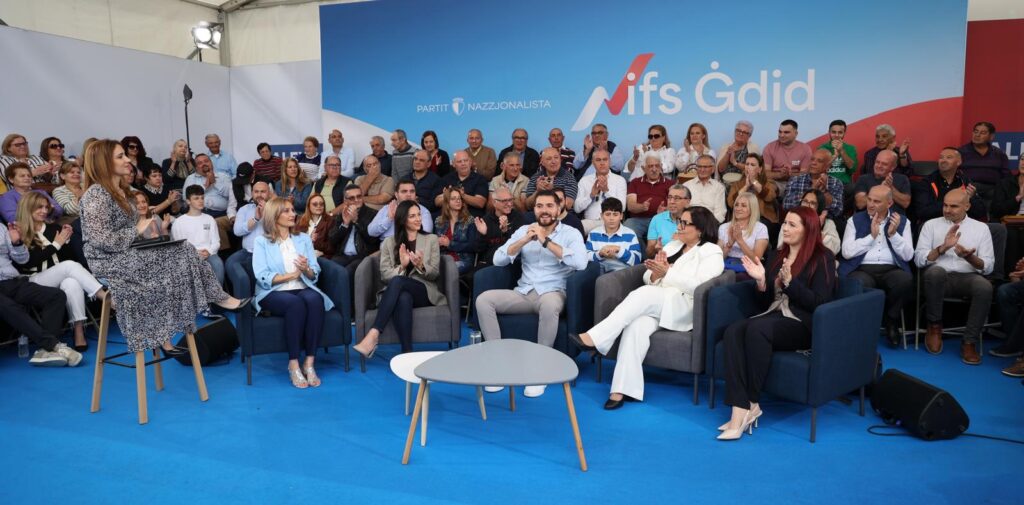
The activity was also addressed by Angele Pulis, Janice Darmanin, Petra Spiteri and Sarah Bajada, in a discussion led by Rebecca Toutoungi. During the activity, the speakers spoke about the challenges faced by students, teachers, parents and families in the education system, as well as the need for education to be given national priority through serious, long-term policy built around people’s needs.
Angele Pulis said that young people today have a wide choice of careers before them, and that this is a new phenomenon around the world. Yet many are still discouraged from pursuing a career in education – including because of low salaries, the stress involved in an education career, and the way the teaching profession is sometimes portrayed in the media. She encouraged all those who wish to pursue a career in education to take that step. She spoke about the importance of much greater investment in STEM subjects, science, engineering and mathematics, and said these are areas where Maltese students are falling behind. She also said that there is a serious shortage of students with trade skills and a lack of students entering nursing courses. She also referred to the lack of preparedness among young people entering the world of work, and to what the Malta Chamber said about the need for radical change in our curriculum, moving away from one that seeks to fill children’s minds with information towards one that gives people the skills to develop. It is pointless to keep throwing money at the problem without a serious strategy to reform education so that it reflects today’s needs.
Janice Darmanin said that one of the issues worrying parents most, in a world that is changing from one day to the next, is whether their children will, in the future, manage to find their place in work that gives them satisfaction. She said that, despite some changes that have been made, education in our country is still too exam-based. She said we must move towards a style of education that develops children’s skills so that they are able to reach knowledge themselves and are able to explore and develop. She explained that just as parents who are about to have a child, or a couple about to get married, attend a course beforehand, but then need support so that after this change in their lives they continue to be guided, the same applies to education. If parents are given support on how to help their children, those children will be able to explore and develop even better. She said that learning should be an enjoyable experience so that it becomes more effective and easier for both students and educators.
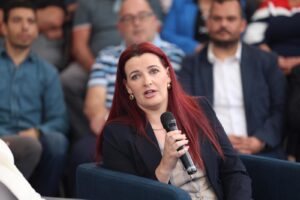
Petra Spiteri spoke about the importance of helping students discover their strongest skills through an education system that serves every student despite their diversity. She said that this is a journey involving students, educators and parents together. She also said that educators’ autonomy is crucial so that they can provide the best teaching to students according to their needs at that particular moment. This is why it is also very important that educators find the full support they need to be able to do this. She said that investment in education is the best investment for a stronger society. Investment in educators must not stop at the financial aspect, but must also include the support they are given and ensuring that their experience as educators is a positive and autonomous one, without unnecessary stress.

For her part, Sarah Bajada said that education is not only about results and academics, and that parents are themselves a school for their children through the way they act and react. She said that parents often feel they must try to be perfect, but children are not looking for perfection – they are looking for support, time and emotional backing. She said that, in addition to focusing on academics, parents should also give importance to their children’s emotional health. This can be done hand in hand with academic development together with educators, so that children develop the skills and holistic knowledge that will help them achieve success in their adult lives.
17.05.2026